Shelter underground
In two world wars, Londoners went down to the platforms to escape the bombs.
How this site works. Every fact is in our own words and linked to its source, beside it. Where good sources disagree, we show each version in a “Sources differ” box.
The First World War
The first ever air raid on London, on 31 May 1915, sent people into Underground stations for shelter. LT Museum, shelters
The Blitz
In the Blitz, from September 1940 to May 1941, deep Tube stations sheltered thousands of people every night. LT Museum, deep shelters
At first the authorities did not want people sheltering in the Underground, but the Blitz changed their minds. LT Museum, shelters
People slept on walkways, platforms and even tracks with the power switched off. LT Museum, shelters
A ‘Tube Refreshments Special’ train delivered food and drink to shelterers. LT Museum, shelters
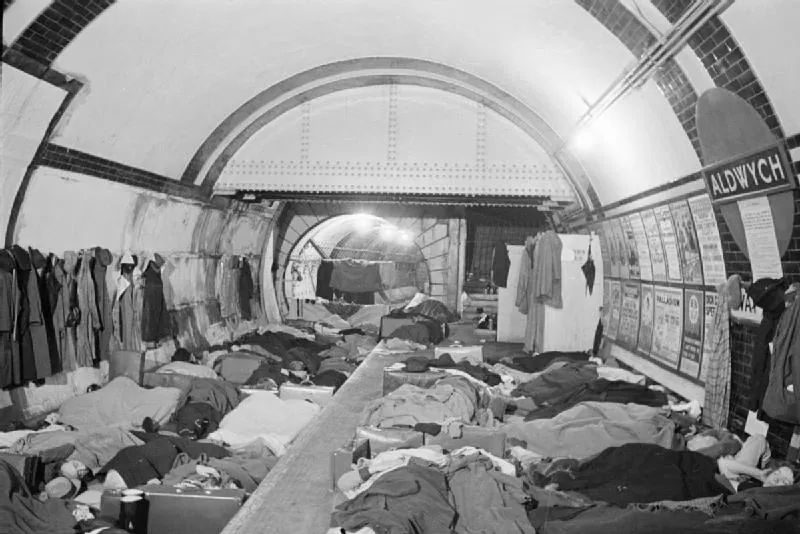
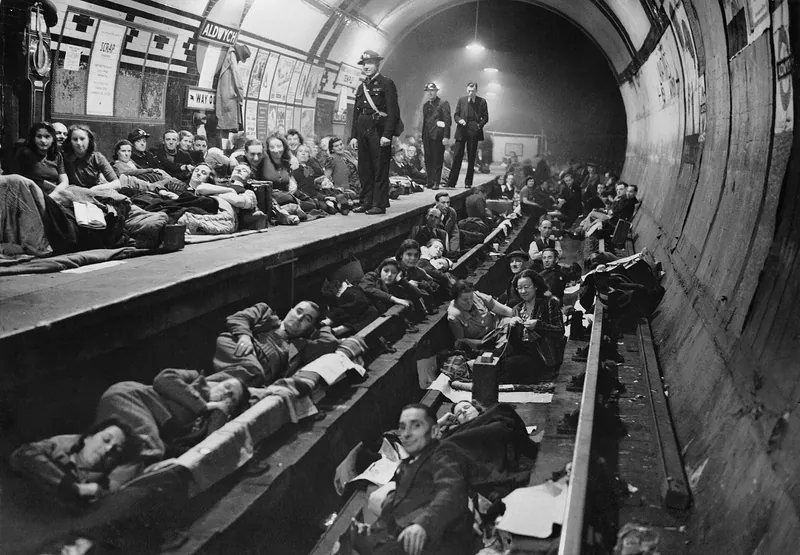
Britannica says that in the wars the unused Aldwych tunnels stored treasures from the British Museum. Britannica
The Aldwych branch of the Piccadilly line closed in 1994, with too few passengers and high costs. TfL
The deep-level shelters
Ten were planned; the two at Oval and St Paul’s were abandoned during building. LT Museum, deep shelters
London Transport built eight deep-level shelters, at Belsize Park, Camden Town, Chancery Lane, Goodge Street, Stockwell, Clapham North, Clapham Common and Clapham South, each for 8,000 people. LT Museum, deep shelters
Their tunnels were dug by hand, 30 metres down and just over 400 metres long. LT Museum, deep shelters
Some opened to the public in July 1944, when V1 flying bombs and V2 rockets were hitting London. LT Museum, deep shelters
Each had eight canteens serving sausage rolls, meat pies and cakes, a treat in a time of strict rationing. LT Museum, deep shelters
Shelterers slept on hard three-tier bunk beds and brought their own bedding. LT Museum, deep shelters
After the war
After the war some shelters housed some of the first people from Jamaica to arrive on the Empire Windrush, in 1948. LT Museum, deep shelters
Our view: it is striking that the authorities did not want people in the Tube at first. Londoners decided for themselves, and the Underground became one of the best-remembered places of the war.
Next: myths →