Picture credits
The drawings are our own. The photos are from Wikimedia Commons, under Creative Commons licences (Attribution, or Attribution-ShareAlike), CC0, or in the public domain.
Photos
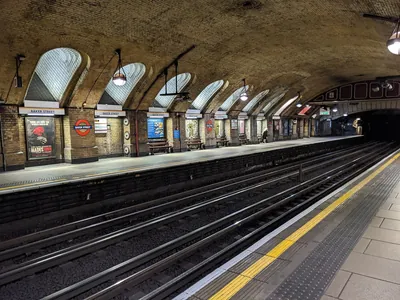 Circle and H&C platforms, Baker Street station, London.jpg
by The wub, CC BY-SA 4.0. Cropped and resized; no other changes. Shared here under the same licence.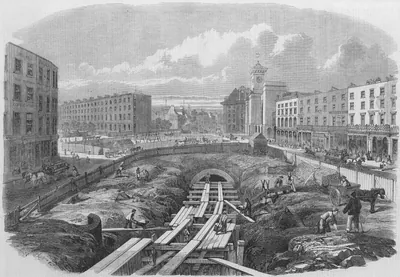 Constructing the Metropolitan Railway.jpg
by Percy William Justyne, Public domain. Cropped and resized; no other changes.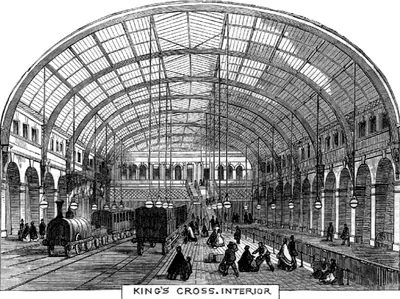 King's Cross Metropolitan Railway Station, Interior - 1862.jpg
by Unknown photographer, Public domain. Cropped and resized; no other changes.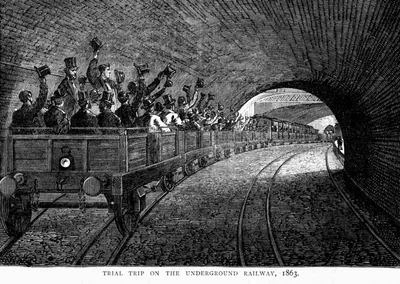 Portland Road Underground Station 1862.jpg
by Unknown artist, Old and New London (Cassell, about 1890), Public domain. Cropped and resized; no other changes.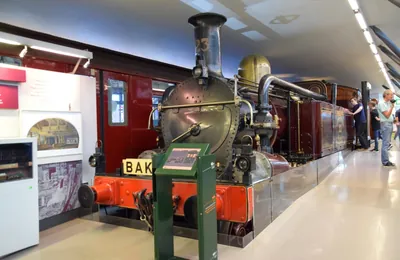 Metropolitan Railway A Class No. 23 at the London Transport Museum - August 2018 - 02.jpg
by nzsteam, CC BY 2.0. Cropped and resized; no other changes.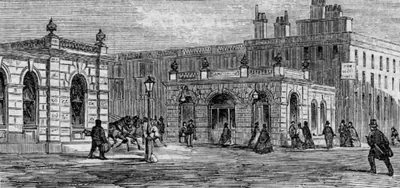 Baker Street tube station, 1862.jpg
by Unknown artist, The Illustrated London News, Public domain. Cropped and resized; no other changes.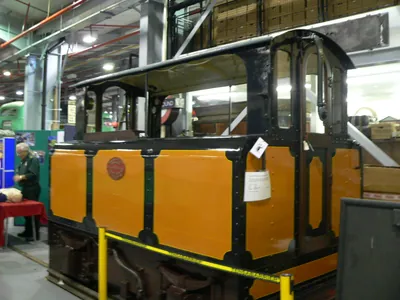 Ltmd-c&slr-number13-01.jpg
by Chris McKenna (Thryduulf), CC BY-SA 4.0. Cropped and resized; no other changes. Shared here under the same licence.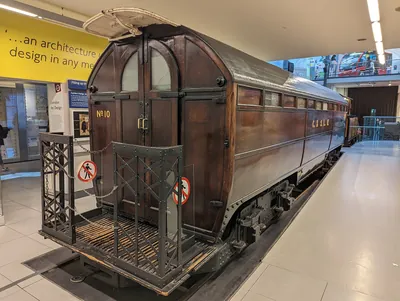 City and South London Railway Padded Cell coach at the London Transport Museum at Covent Garden.jpg
by The Basingstoker, CC BY-SA 2.0. Cropped and resized; no other changes. Shared here under the same licence.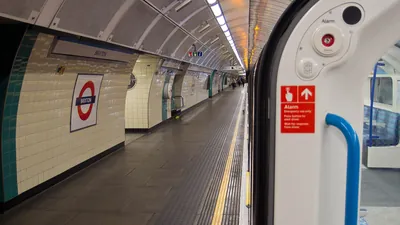 Victoria Line 2009 stock at Brixton.jpg
by Ed Webster, CC BY 2.0. Cropped and resized; no other changes.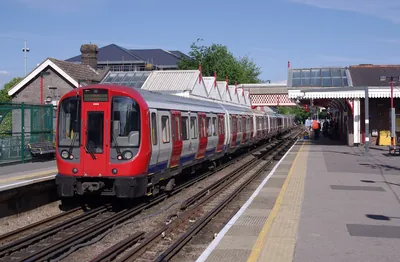 Amersham station MMB 18 S Stock.jpg
by mattbuck, CC BY-SA 3.0. Cropped and resized; no other changes. Shared here under the same licence.
 LondonUnderground roundel on Holborn station exit.jpg
by The wub, CC BY-SA 4.0. Cropped and resized; no other changes. Shared here under the same licence.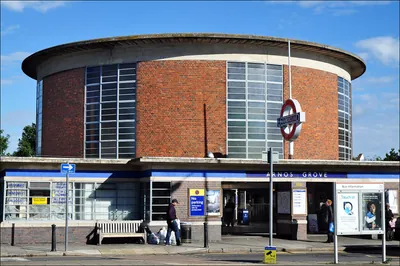 Arnos Grove Tube Station (8108109937).jpg
by Images George Rex, CC BY-SA 2.0. Cropped and resized; no other changes. Shared here under the same licence.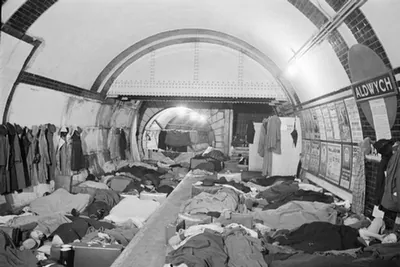 The London Underground As Air Raid Shelter, London, England, 1940 D1675.jpg
by Ministry of Information Photo Division, Public domain. Cropped and resized; no other changes.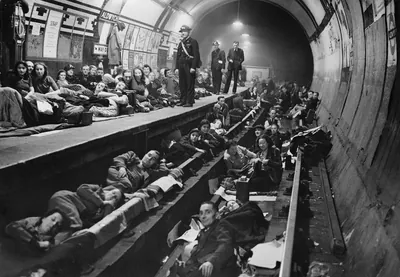 The Home Front in Britain during the Second World War HU44272.jpg
by Unknown photographer, Public domain. Cropped and resized; no other changes.
Our own drawings
- A cross-section under a street. Near the surface, a cut-and-cover tunnel: a brick-lined trench with a brick arch roof and a steam train inside; the text says the trench was about 10 metres wide and 6 metres deep, and the road was rebuilt on top. Much deeper, a round tunnel lined with cast-iron rings with an electric train inside; the text says a shield was pushed through the clay, the tunnel was deep enough to miss foundations and pipes, and deep tubes needed electric trains and safe lifts.
Our own drawing - A timeline from 1860 to 1980 showing when the first part of each of the 11 lines opened: Metropolitan 1863, Hammersmith and City 1864, District 1868, Circle 1884, Northern 1890, Waterloo and City 1898, Central 1900, Bakerloo 1906, Piccadilly 1906, Victoria 1968, Jubilee 1979.
Our own drawing - Two drawings of the same invented railway with three lines. On the left, drawn like a street map, the lines curve and wander and the stations in the centre are crowded together. On the right, drawn Beck’s way, the lines are straight, bend only at 45 degrees, and the centre is spread out so it is easy to read.
Our own drawing - A cross-section showing two depths below the street: the 1860s cut-and-cover trench at about 6 metres, and the 1940s deep-level shelters at 30 metres, each just over 400 metres long, for 8,000 people.
Our own drawing
The drawings are simplified teaching drawings, not to scale, made from the sourced descriptions on this site. Useless the eraser is the network’s own mascot. Fonts: Bricolage Grotesque, Newsreader and Kalam (SIL Open Font Licence), served from this site.